

Official websites use .gov
A .gov website belongs to an official government organization in the United States.

Secure .gov websites use HTTPS
A lock (
) or https:// means you’ve safely connected to the .gov website. Share sensitive information only on official, secure websites.


Measuring the Performance of Net-Zero Energy Homes
Summary
A Net-Zero Energy Residential Test Facility (NZERTF) has been constructed and extensively instrumented. The facility incorporates a high-performance envelope, a mechanical ventilation system with heat/energy recovery, three distinct ground-source heat exchangers, a radiant basement floor heating system, a whole house dehumidifier, scalable photovoltaic and thermal solar systems, and three separate supply duct systems for distributing conditioned air throughout the house. Two of these supply duct systems include an excessive number of outlets, which can be individually opened or closed (in one case by using electronic dampers) to permit duct system reconfiguration and zoning. The heat loads, the hot water draw profile, and the electrical plug loads generated by a typical family are replicated using computer-controlled devices located throughout the facility.
The NZERTF has been used to demonstrate, via measured field performance and validation of whole-house computer models, that a home similar in size, aesthetics, and amenities to those in the surrounding communities can generate as much energy as it consumes on an annual basis while meeting all of the functional needs of the occupants (http://www.nist.gov/el/nzertf). More importantly, the NZERTF provides a platform for comprehensive measurements to explore various designs, technologies, and control strategies for achieving net-zero energy performance. Moreover, the NZERTF serves as an exemplary test bed for energy efficient, renewable energy, energy storage, and smart-grid technologies. The insight gained, lessons learned, and data generated from this project will provide information to the building industry to enable advances in efficient residential construction and will result in measurement science that accurately characterizes the performance of several technologies. The data generated from this project will support the development of validated and improved building energy and indoor air quality models that will be used to design the next generation of single-family housing.
Description
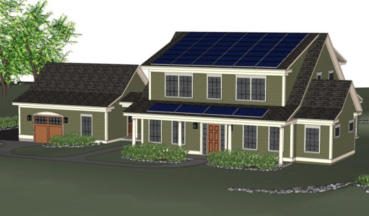
Objective: Develop the measurement science necessary to evaluate various technological approaches to achieve net-zero energy residential buildings, including innovative monitoring techniques, methods of test, performance metrics and high quality experimental data for the validation and improvement of building energy and indoor air quality models.
What is the new technical idea?
NIST’s “Measurement Science Roadmap for Net-Zero Energy Buildings” emphasized the need for improved monitoring techniques, metrics, and models to assess the energy performance of net-zero energy buildings (NZEB). Additional measurement science needs addressing barriers to the design, construction, and operation of net-zero energy buildings have been provided by the building industry. The NZERTF is a test bed that is used to address these measurement science needs and develop performance metrics for emerging technologies. Methods to optimize the overall performance of the facility will also be explored. This unique facility also enables our researchers to characterize interactions between various subsystems and quantify their impact and influence on the methods of test used for individual subsystems. Development of the measurement science required to understand how net-zero energy buildings can be designed/constructed in the most effective manner will result in greater numbers of low-energy homes being constructed.
What is the research plan?
The NZERTF will be operated using various technologies and control strategies to determine various means to achieve net-zero while maintaining, and preferably enhancing, the quality of the indoor environment. The experimental work will be complemented by computer simulations to identify the most promising approaches and economic analysis to determine the most cost-effective approaches.
During two 12-month demonstration periods, the NZERTF achieved net-zero energy operation while meeting the demands of a typical family of four and being subjected to weather conditions that were more extreme than normal. For each demonstration period, the house’s subsystems were configured differently. Comparisons of the measured performance from the two periods revealed the significant impact of the thermostat on the performance of the heat pump system, especially when operating in the heating mode. Another key result was the quantification of the energy costs for code compliant versus “beyond code” levels of mechanical ventilation with sensible heat recovery. The capacity, efficiency, and interaction effects from using two different methods for providing supplemental, whole-house dehumidification was quantified. Additionally, the impact of sizing auxiliary space heating resistive elements based on a worst case need (i.e., emergency heating on the coldest days if the heat pump fails) compared to a lesser power level was investigated. With respect to the overarching goal of demonstrating net-zero energy performance, the amount of energy returned to the grid exceeded the amount of grid-provided energy consumed in the house over the 12-month period by 4 % using the first configuration and by 18 % using the second configuration.
Several methods to heat and cool the house were built into the facility when it was originally constructed. So far, two variations of a two-capacity air-source heat pump connected to a conventional duct system have been studied over multiple seasons. For one variation, the heat pump’s unique dedicated dehumidification capability was disabled, and its auxiliary resistive heater was downsized. An alternative central heat pump system, a small-duct high-velocity (SDHV) system, was also studied over several seasons. Data were collected while using the full SDHV duct system and a subset of air supplies as well as when operating using two different control schemes, one geared towards maximizing capacity and comfort versus an alternative that prioritized maximizing efficiency. During the past year, space conditioning in the NZERTF has been focused on the two-speed heat pump, but now while operated using different configurations of the conventional duct supply system. In addition, simplified supply duct zoning control was also implemented for a subset of these duct configurations. Energy consumption of the heat pump systems and the thermal comfort provided by these systems was measured and quantified. To expand the team’s means for evaluating thermal comfort, a measurement system consisting of a reconfigurable, 3-dimensional array of temperature, humidity, and air flow sensors was installed within an upstairs bedroom of the NZERTF.
A focus in the upcoming year will be achieving more uniform thermal conditions and fewer hours of either extremely dry or humid conditions in well-sealed and highly insulated homes like the NZERTF. The more efficient thermal envelope reduces the sensible demands, thus allowing the heating and cooling system to be down-sized. As a consequence, the volumetric rate of air circulated by the indoor blower(s) is proportionally reduced. The impact on thermal comfort and energy consumption will be evaluated based on investigating different options for where to introduce and return the reduced air volume. Different supply duct configurations and zoning strategies will be applied. The impacts of changing the allocation of air returned to the heat pump unit at the four grills and using the smaller, less costly duct system associated with the SDHV system attached to the conventional heat pump will be investigated. The results will contribute to improving duct design procedures and to quantifying the merits of incorporating zoning within net-zero energy homes.
During the latter half of FY20, a ground-source heat pump system will be installed, instrumented, and commissioned in the NZERTF. Lab testing to fully characterize the performance of the ground-source heat pump, including operating modes where it provides domestic water heating, will be completed in advance of installing the unit in the NZERTF.
The domestic hot water system in the NZERTF is reconfigurable, allowing for detailed studies of a range of water heating options. These options include single- and two-tank systems with and without solar thermal preheating. Among the options for the main water heater, it can be electric resistance only, gas-fired, an integral (indoor) heat pump water heater, a remote (outdoor) heat pump water heater, or electric resistance with water heating supplied by the central air-source or ground-source heat pump. Water heating options evaluated so far have included an integral heat pump water heater with and without solar thermal preheat. Notably, the working fluid used by the integral heat pump water heater is a conventional, synthetic refrigerant, R-410A. In the latter half of FY19, an alternative heat pump heater, which uses CO2 as the refrigerant and locates both its evaporator and condenser outdoors will be installed, instrumented, and commissioned. As compared to the previously evaluated integral heat pump water heater, the evaporator of this CO2 unit will not affect the home’s space-conditioning load. In addition, the CO2 unit is expected to perform at comparatively higher efficiencies. Installed performance will be evaluated over at least a 12-month interval. The field performance will be compared to the performance projected using laboratory test results.
Following field evaluation of the CO2 unit, the team will explore a water-heating system that is combined with a ground-source heat pump. Laboratory testing to characterize the different water-heating modes of the combined space-conditioning and water-heating ground-source heat pump will be concluded in FY20. Those laboratory results will be used in comparing to field performance once the combined system is installed and monitored in the NZERTF.
An important aspect of any high-performance home is to provide indoor air quality that meets or exceeds ASHRAE standards and other relevant guidelines. Sufficient ventilation of the home is critical for achieving good indoor air quality. Preliminary computer models have been developed of the ventilation rates and projected contaminant levels, but there is uncertainty in the rate of outdoor air change of the facility and the effectiveness of ventilation in removing contaminants. This shortcoming complicates evaluations of alternative ventilation strategies that could prove to be more effective or more energy efficient. To help assess the performance of ventilation systems, EL researchers designed a CO2 injection and sampling system in FY18, have installed the system in FY19, and operate it thereafter. This system will allow a more complete characterization of the contaminants emitted by the occupants and the evaluation of various CO2-based IAQ metrics. In conjunction with a tracer gas system installed in FY18, this CO2 injection and monitoring capability will allow for in-depth characterization of ventilation effectiveness and enable the team to examine demand-controlled ventilation. One objective in FY20 is to collect data that can be used to validate a coupled CONTAM-EnergyPlus model that can then be used to assess the effectiveness of demand-controlled ventilation in a broad range of homes.
NIST will continue to make data from the NZERTF available to the public. The data releases are complemented with documentation that describes the data and provides sample calculations. Currently the team is pursing inclusion on two different DOE-funded collaborations that make use of NZERTF data sets from past whole-house measurements and data generated from future short term tests that focus on the heating and ventilation systems. In the future, field data that quantifies the performance of the NZERTF solar photovoltaic array and the local weather conditions will be considered for public dissemination as a NZERTF dataset.
To explore alternatives to other energy consuming devices in net-zero energy homes, three incremental steps will be taken in FY20. First, the existing NZERTF heat recovery ventilator will be replaced with an energy recovery ventilator, which transfers moisture (latent heat) in addition to sensible heat. Subsequent full year performance measurements will help quantify the trade-offs when selecting among different ventilator options. Second, because of its significant impact on annual energy consumption, a laboratory study is being conducted in FY19 to understand the energy saving benefits versus performance changes associated with using an advanced clothes dryer. In FY20, the same advanced clothes dryer will be installed in the NZERTF and then monitored for several months thereafter. Finally, the existing single-packaged whole-house dehumidifier will be replaced with a unit having a remote condenser. Industry stakeholders are currently working on design and sizing guides for this appliance category, and the existing test standards need to be updated; field performance data on an alternative whole-house dehumidifier will aid these efforts.