Official websites use .gov
A .gov website belongs to an official government organization in the United States.

Secure .gov websites use HTTPS
A lock (
) or https:// means you’ve safely connected to the .gov website. Share sensitive information only on official, secure websites.


Resonating Platforms for Microbial, Environmental, and Materials Sensing
Summary
The Resonating Platforms project is focused on developing resonant-acoustic devices and methods for characterizing the interactions of microbes with chemical and physical environments, sensing chemical and physical parameters of environments at elevated temperatures, and measuring high-temperature thermophysical properties of small quantities of materials.
Description
The high sensitivity of resonating piezoelectric crystals to surface perturbations has led to quartz crystal microbalances (QCMs) being widely used to measure changes in mass of thin films and adhered nanoparticles or cells. This project proceeds beyond this traditional sensing approach with quartz resonators to the development of innovative resonant devices, methods, and measurement systems that provide new types of information and/or enable deployment in extreme environments. The research currently spans a variety of specific subject areas, including characterization of the response of bacteria to antimicrobial agents, interactions of microbes with surfaces in biofouling of infrastructure, characterization and optimization of innovative piezoelectric crystals for operation at temperatures that exceed the limits of quartz, and micro-thermogravimetric analysis of nanoparticles and thin films.
Rapid sensing of biophysical responses of bacteria to antibiotics
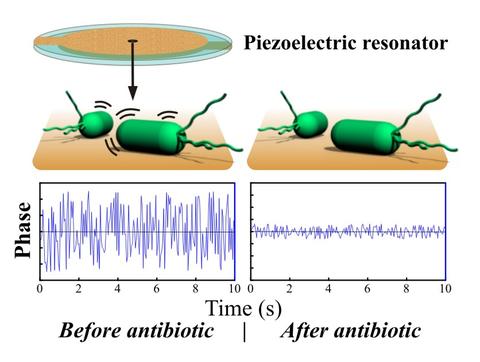
Finding the right treatment for an unidentified infection can be slow and problematic with current clinical techniques. In the worst cases (e.g., sepsis), diagnostic delays dramatically raise the mortality rate. In more everyday situations, delays incentivize physicians to over-prescribe broad-spectrum antibiotics and thereby contribute to the emergence of antibiotic-resistant bacteria, which is a major societal threat. We seek to address this problem by developing a method for rapidly sensing changes in dynamics associated with the mechanics of cell metabolism, motility, and/or growth. Our approach involves adhering a population of microbes in solution to the surface of a resonating piezoelectric crystal and measuring the phase noise from an electronic bridge that incorporates the resonator and is driven by an ultra-high-stability frequency source. Mechanical fluctuations of microbes are found to introduce resonator phase noise, and viable bacteria are found to introduce more noise than nonviable bacteria. We have demonstrated initial proof of concept of this sensing approach with motile and nonmotile E. coli exposed to two antibiotics, ampicillin and polymyxin B, with different mechanisms of action. Phase noise is found to drop within half an hour of introducing each of these antibiotics. The times for these measured changes are within the range necessary for effectively dealing with fast-moving infections in clinical settings. If this sensing approach is found to be applicable to a broader range of microbes and antibiotics in at least one diagnostic area, it will enable quick and direct evaluation of antibiotic efficacy and could become a powerful tool in defending against fast-moving infections and antimicrobial resistance.
Interactions of biofilms with infrastructural materials
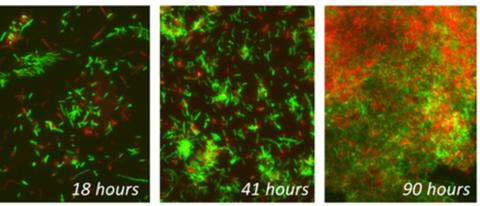
Biofilm formation during the course of several days has been monitored with a QCM system that provides measurements of both frequency and dissipation at several resonant overtones. Figure 2 shows images of fluorescently labeled bacterial films during growth on a crystal that has a thin film of iron on the surface. The QCM measurements have revealed signatures of early adhesion of cells implicated in microbiologically influenced corrosion and membrane biofouling. Information on cell/substrate bond maturation time and bond stiffness is being pursued through analysis of resonator dissipation and frequency changes, respectively.
High-temperature piezoelectric crystals
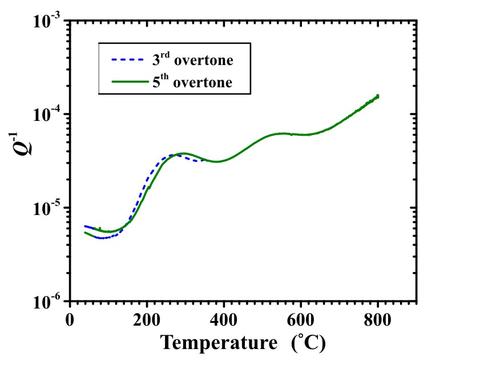
For a variety of high-temperature sensing applications (including micro-theromogravimetric analysis, described below), quartz has substantial limitations related to its temperature limit of 573 °C (crystallographic phase-transition temperature) and intrinsic temperature dependence of resonant frequencies. To address these issues, innovative piezoelectric crystals in the “langasite family,” especially Ca3TaGa3Si2O14 (CTGS), are being studied and optimized in collaboration with Clausthal University of Technology (Goslar, Germany) and Leibniz Institute for Crystal Growth (Berlin). CTGS remains piezoelectric up to approximately 1400 °C, and effective acoustic resonance measurements have been demonstrated at temperatures up 1100 °C. Research on this topic at NIST involves the use of a unique high-temperature resonant-ultrasonic system that employs noncontacting transduction to accurately measure temperature- and overtone-dependent quality factors (Qs) (Fig. 3) and enable a determination of intrinsic and defect-related contributions to the material damping.
Micro-thermogravimetric analysis
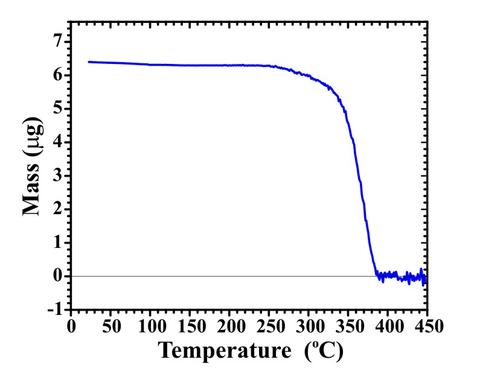
Methods are being developed for resonator-based thermogravimetric analysis (µTGA) of material coatings with substantially smaller masses than those required for conventional bulk thermogravimetric analysis (TGA). Mass resolution and repeatability of continuously-ramped µTGA have been explored with a system built around an SC-cut quartz microbalance. Tests were performed on poly(methyl methacrylate) (PMMA) during thermally activated decomposition and combustion (Fig. 3). On the basis of these tests, the system was found to have one-to-two orders of magnitude lower noise in determined mass, below 200
°C, than high-resolution conventional bulk TGA, and to have at least an order of magnitude lower drift over the entire measured temperature range.