| * |
|
|
Welcome
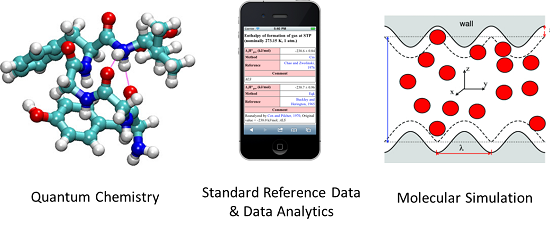
The Chemical Informatics Research Group develops and applies theory and simulation at various length and time scales to calculate a wide variety of chemical and physical properties of gas, liquid, and solid molecular systems. The Group establishes the accuracy of computational methods by compiling comparisons to measured values. It develops new algorithms for chemical informatics, data analysis, and molecular simulation, as well as new standards for the management, validation, and dissemination of computational and experimental data. The Group’s efforts are performed in support of measurement science in areas such as chemical manufacturing, environment and climate, energy, biomedical and health, and advanced materials. Programs/Projects
NIST Standard Reference Simulation Website—The Standard Reference Simulation Website is an ongoing project whose aim is to provide well-documented simulation results for a variety of systems and from various simulation techniques. The … A Fundamental Study of the Conformational Phase Behavior of Chain Molecules at Interfaces—Chain molecules tethered or adsorbed to solid surfaces are at the heart of a wide range of technologies. Examples include colloidal particle stabilization, chromatographic materials, and drug … Theoretical Mass Spectrometry—Mass spectrometry is an important technique in analytical chemistry, essential in areas including drug development, criminal and agricultural forensics, detection of … Explosives Decomposition Chemistry —High-energy materials are commonly used as military explosives and as advanced propellants. The detailed chemical reactions responsible for detonation, deflagration, combustion, and slow aging are … Virtual Measurements—Compared with conventional, physical measurements, the cost of computational modeling continues to drop. This has driven many industries to incorporate computational predictions in their … Reactivity of Nanoparticle Catalysts—Transition metal nanoparticle catalysts show great promise as the key enabling breakthrough for the realization of efficient and economical fuel cells. These, in turn, will provide a sustainable … Prediction of Global Warming Potential—The global warming potential (GWP) of a number of compounds used by U.S. industry is not known or poorly known. Working with the EPA, a set of nearly 1,200 compounds that are known or reasonable … Thermodynamics of ATP in Solution—Quantum chemical calculations have proven to be a reliable tool for the prediction of thermodynamics quantities, particularly for smaller organic species. Computations of the thermodynamics of … Density Functional Tight Binding Methods—Density Functional Tight Binding (DFTB) methods have been shown to be capable of producing reliable molecular structures and energetics at a significantly reduced computational cost. The … Solvation Thermodynamics—Using data from REFPROP 8.0, thermodynamic quantities for the self-solvation of 76 pure fluids were computed. These quantities are valuable for comparison to similar data derived from experiment, … NIST Chemistry Webbook—The NIST Chemistry WebBook is a site on the Internet (http://webbook.nist.gov/) that provides convenient access to a variety of physical and chemical property data on well defined chemical species … Understanding Protein Solution Phase Behavior via Coarse-Grained Modeling—Much of our knowledge of protein folding comes from experiments on polypeptides in dilute solutions or from theoretical models of isolated proteins. However, neither biological cells nor protein … Connecting Thermodynamic and Dynamic Properties of Bulk and Confined Fluids—It is well known that the physical properties of a fluid can change profoundly, and often non-trivially, when placed in a confined environment. Only for the simplest of fluids do there exist … |
Products and ServicesNIST Chemistry WebbookNIST Computational Chemistry Comparison and Benchmark DatabaseNIST Standard Reference Simulation WebsiteNIST Chemical Kinetics Database (gas phase)Fluid Properties Simulation ChallengeProgram for Computing Ideal-Gas Thermodynamic FunctionsPC/Windows program for computing vibrational levels for non-harmonic potentialsPolymer Mass Spectrometry MALDI Recipes
Contact
Dr. William E. Wallace III (Group Leader) |