

Official websites use .gov
A .gov website belongs to an official government organization in the United States.

Secure .gov websites use HTTPS
A lock (
) or https:// means you’ve safely connected to the .gov website. Share sensitive information only on official, secure websites.


Fundamental Physics: Magnetically Trapped Neutron Lifetime Experiment
Summary
The decay of the free neutron is the simplest nuclear beta decay and is the prototype for all charged current semi-leptonic weak interactions. The decay parameters, the neutron lifetime in particular, provide essential inputs to investigations of the weak interaction. This experimental effort represented a unique approach to measuring the neutron lifetime using ultracold neutrons in a three-dimensional magnetic trap. The technically complex cryogenic experiment successfully demonstrated the measurement concept and laid the groundwork for future effort.
Description
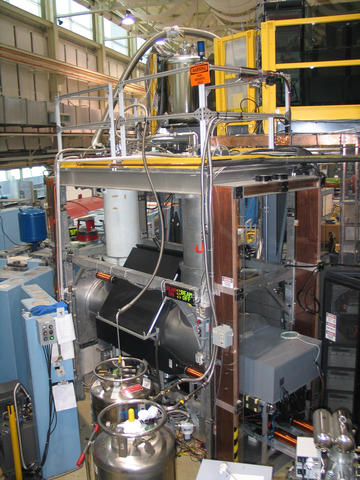
Operating magnetic trap for ultracold neutrons
A precise value for the neutron lifetime is required for several internal consistency tests of the SM including searches for right-handed currents and tests of the unitarity of the CKM mixing matrix. Measurements of neutron decay coefficients provide information on the vector and axial-vector coupling constants gv and ga. The neutron lifetime is also an essential parameter in the theory of Big Bang Nucleosynthesis and in determinations of the expected neutrino flux from nuclear reactors.
At present there remains a discrepancy between determinations of the neutron lifetime obtained from neutron traps when compared to those coming from neutron beam techniques. This discrepancy is not currently understood. It is essential to resolve this disagreement, a goal that can best be accomplished through measurements using systematically different techniques. As beam-type experiments are limited by measurements of the neutron flux and material bottle experiments are complicated by wall interactions, magnetic trapping techniques offer a powerful approach for both solving this discrepancy and improving the precision of the neutron lifetime.
This program was a collaborative effort between NIST and NC State. The experiment was designed to measure the neutron beta-decay lifetime using a substantially new technique with potential systematic advantages. Ultra Cold Neutrons (UCN) were confined within a three-dimensional magnetic trap. Cooling of the neutrons occurs within the conservative trap when 12 K neutrons (0.89 nm) down-scatter in superfluid 4He to near rest via single phonon emission (superthermal production). The UCN then interact only with the magnetic field via their magnetic moment and when the spin is anti-parallel to the magnetic field, they will seek to minimize their potential energy by moving towards low field regions. By cooling the trap to temperatures of approximately 100 mK, the population of UCN becomes thermally detached from the helium bath allowing accumulation of UCN. Neutron decay is detected by turning off the cold neutron beam and observing the scintillation light resulting from the beta-decay electrons. When an electron moves through liquid helium, it ionizes helium atoms along its track. These helium ions quickly recombine into metastable He*2 molecules. About 35 % of the initial electron energy goes into the production of extreme ultraviolet (EUV) photons from singlet decays, corresponding to approximately 22 photons/keV. These EUV photons are frequency down-converted to blue photons using the organic fluor tetraphenyl butadiene (TPB) coated onto a diffuse reflector surrounding the trapping region. This light is transported via non-imaging optics to room temperature and detected by two photomultiplier tube (PMT)s operating in coincidence. This unique trapping and detection method allows the observation of neutron decay events in situ, and therefore directly measure the decay curve, a unique aspect of this experimental approach at the time.
There have been multiple stages in the development of this technique. In 2010 we completed construction of a significantly upgraded apparatus that was projected to reach a sensitivity competitive with, or surpassing, the best measurements at that time. Data was collected from fall 2010 through spring 2011. Trapped neutron densities were roughly in-line with expectations, but backgrounds were higher despite significant success developing pulse shape discrimination methods for the trap. The poor signal-to-background combined with an unplanned end to operations limited statistical sensitivity to roughly ten seconds. While not a competitive lifetime measurement, detailed systematic studies were successfully carried out that supported a detailed understanding of the ultimate potential of the technique. Significant effort was put into understanding the two dominate systematic effects, marginally trapped neutrons (neutrons that remain in the trap for long periods in spite of have a total energy above the trap depth) and absorption on residual 3He in the trap. The former has necessitated the development of a detailed Monte Carlo that is proving useful to other collaborations, while the latter motivated the formation of a collaboration with Argonne National Laboratory that pushed the capability of Accelerator Mass Spectroscopy (AMS) several orders of magnitude in sensitivity. Based on these studies, the experimental approach remains a viable path forward to a competitive neutron lifetime measurement, though there is no current effort to realize such an experiment.