An official website of the United States government
Here’s how you know
Official websites use .gov
A .gov website belongs to an official government organization in the United States.
Secure .gov websites use HTTPS
A lock (
) or https:// means you’ve safely connected to the .gov website. Share sensitive information only on official, secure websites.
Consumers have varying levels of awareness of measurement in daily life. Since the National Bureau of Standards (NBS, now NIST) Mendenhall Order in the late 1800's, many everyday measurements have been traceable to metric units. Many are not aware that "below the surface" the SI is the foundation for all measurements or of the extent the SI is used by industry to manufacture and supply the goods and services we all use every day. While it’s true that metric use is mandatory in some countries and voluntary in others, all countries have recognized and adopted the SI, including the United States. Busting Myths about the Metric System explores several common misconceptions about U.S. Metrication.
Metrication Progress
Metric Act of 1866
Credit:
National Archives
Metrication, metric transition, metric conversion, or metrication are terms used to describe moving from use of local, traditional, or customary units of measure to the SI. Current U.S. metricationprojects, best practices, case studies, errors and mishaps and much more is available. Metric transition accelerated shortly after the 1975 Metric Conversion Law was enacted and national Metric Policy was established to increase the voluntary use of the metric system as the preferred system of measurement for trade and commerce. One of the first industry sector transitions occurred with Distilled Spirits & Wines, where transition was initiated by U.S. industry and coordinated by the U.S. Department of Treasury. Distilled Spirits and Wines have been successfully sold exclusively and accepted by U.S. consumers in metric units since the early 1980's. To learn more, explore the answers to metrication frequently asked questions (FAQs).
SI Everyday
Learn and use the SI to elevate every day with these practical life hacks:
Communication – Understand measurements whether you’re talking or writing to someone in your town or on the other side of the globe.
Estimation – Develop the ability to estimate metric measurements without using tools. This skill helps interpret the world around us.
Gardening – Measure plant spacing, garden plot area, rainfall calculations, and watering with metric units.
Health Awareness – Monitor your health using metric units for height, weight, and blood pressure. Track fitness progress with metric measurements.
Shop Savvy – Use metric units found on product labels when shopping for groceries and products. Make informed value comparisons with metric unit pricing.
Sports and Recreation – Enjoy outdoor activities and sports using metric units, such as bicycling, running, and swimming.
Temperature Comfort – Use degree Celsius for understanding climate temperature conditions, weather forecasts, and setting thermostats.
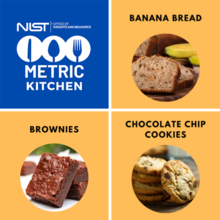
Trio of NIST Metric Recipes. Credit: NISTCooking Confidence – Metric system measurements simplify cooking and baking. NIST Metric Kitchen. Explore the recipe gallery and culinary measurement guidance such as measurement tips, cookware and tools, and culinary temperature. Use NIST Special Publication (SP) 1290, NIST Metric Recipes to help build experience using a kitchen scale to measure ingredients in grams. K-12 educators teaching cooking techniques and students studying life skills topics will enjoy making metric measurements everyday. Preparing a metric system-based recipe is an opportunity to apply culinary math, expand measurement skills, interpret instructions, complete steps in a necessary sequence, troubleshoot, build self-confidence, and enjoy the delicious results! Cooking and baking are ideal for teaching Science, Technology, Engineering, and Math (STEM) as well as measurement sense making.
Use of SI measurements includes areas such as media reports (e.g., stories concerning global warming refers to metric tons of CO2 emissions, military deployments using kilometers), time (second), electric current (ampere, volt, ohm & watt), sports (track and field, cycling, Olympics), package labeling (especially beverages), healthcare (blood pressure, cholesterol levels, glucose measurements, prescription and over-the-counter medicines, and dietary supplement dosages), automotive (engines, tires, navigation systems, speedometers), and other consumer products (cameras, film, pens). U.S. consumers are familiar with grams and milligrams through information provided on mandatory nutritional labeling. Advertising, coupons, and consumer product packaging are increasingly found using metric units exclusively.